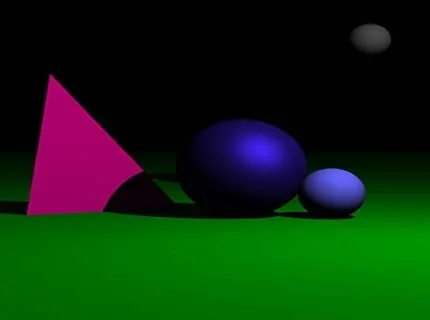
Approach
Cast a ray for every pixel. Recurse where it gets interesting.
For each pixel, the camera fires a primary ray into the scene. The closest hit determines the surface; the surface's material decides whether to shade locally, reflect, refract, or all of the above. Reflections and refractions spawn secondary rays, and the colour bubbles back up the call stack.
Primary rays
Per-pixel ray casting from a pinhole camera with adjustable FOV. Closest-hit detection over spheres, planes, and triangle meshes.
Shading
Phong + Blinn-Phong with ambient, diffuse, and specular terms. Per-light shadow rays for hard shadows; jittered samples for soft shadows.
Reflection
Recursive mirror rays bounded by a configurable depth. Roughness-driven cone sampling for glossy surfaces; perfect mirrors at depth 0.
Refraction
Snell's law for transmissive materials with index-of-refraction per surface. Schlick's approximation drives the Fresnel mix between reflection and refraction.
Antialiasing
Supersampled AA. NxN sub-pixel jittered samples averaged per pixel — the single biggest visual quality win for the smallest amount of code.
Acceleration
Bounding-box pruning for mesh hits. Intersection routines were the hot path, so I templated the math types and inlined the dot/cross helpers.
// Core recursion — abridged from the actual implementation
Color trace(const Ray& r, int depth) {
  if (depth > MAX_DEPTH) return Color{0,0,0};
  Hit h;
  if (!scene.intersect(r, h)) return background(r);

  Color local = shade(h, scene.lights);            // Phong + shadow rays
  Color refl  = h.material.kr > 0
              ? trace(reflectRay(r, h), depth + 1) // recursive reflection
              : Color{0,0,0};
  Color refr  = h.material.kt > 0
              ? trace(refractRay(r, h), depth + 1) // Snell's law
              : Color{0,0,0};

  double fresnel = schlick(r.dir, h.normal, h.material.ior);
  return local + fresnel * refl + (1 - fresnel) * refr;
}